AI Without The Hype · 08 / 08
How Text-to-Image AI Is Assembled From Familiar Parts
The AI that turns a prompt into a picture is not one invention. It is familiar parts wired together, and building one that ships well is a judgement call.
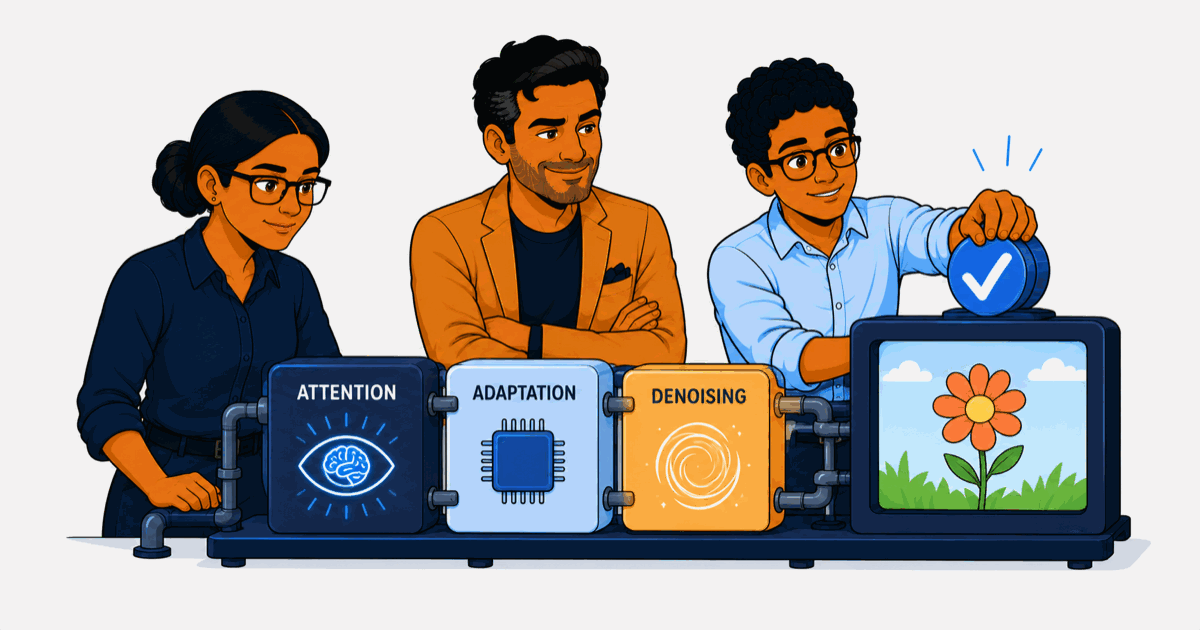
Key takeaways
- Modern multimodal AI is a composition of building blocks from across this series, not a single new invention.
- The same attention idea that reads sentences also reads images, and one shared map lets text and pictures speak the same language.
- Assembling one is the easy part. Shipping it responsibly, with human review and honest limits, is the judgement that decides whether it is good or merely working.
Vision joins the club that attention built
The engine that reads a sentence turns out to read a picture just as well, with one small trick. Chop an image into a grid of small square patches, then treat each patch like a word in a sentence. Now the same attention mechanism from earlier in this series can relate every patch to every other patch, all at once. That is a Vision Transformer, and its strength is that it takes in the whole image at a glance rather than building up understanding from tiny local views. For spotting fraud on a document, that matters. A forgery often hides as a subtle mismatch between two fields sitting far apart on the page, a date that does not agree with an amount, and a model that compares every region to every other catches that in a single look. As always, you rarely train one from scratch. You take a capable pre-trained model and adapt it, the same cheap specialisation from an earlier chapter. The approach was introduced by Dosovitskiy and colleagues in 2020.
Teaching words and pictures to share one language
The real unlock for anything that mixes text and images is a shared map. A model called CLIP was trained on hundreds of millions of image and caption pairs pulled from the web, with one goal, put a picture and the words that describe it in the same spot on a single map, and push mismatched pairs apart. Do that at enormous scale and text and images end up speaking one common language. A photo of a cat and the phrase "a photo of a cat" land in nearly the same place, while that photo and the words "a photo of a car" land far apart. That one shared map is quietly the connective tissue behind most modern vision and language tools, and it was set out by Radford and colleagues in 2021.
The shared map buys something that looks like magic and is really just geometry. You can classify images into categories the model was never trained on, with no retraining at all. Want to sort documents into invoices, contracts, and receipts. Write each label as a short sentence, drop it onto the map, and for any image pick the label sitting closest to it. Because the model reasons about descriptions rather than a fixed list of labels, it handles combinations it has never seen, which is exactly why it holds up across tasks where a traditional classifier trained on one dataset would fall apart.
In plain terms: a shared map for text and images
A single space where both words and pictures are placed as points, trained so that matching pairs sit close together. Once text and images live on the same map, everything becomes a matter of distance. Find the words nearest a picture to describe it, find the picture nearest some words to retrieve it, or aim a generator at the point some words occupy to create it. It is the common language that lets one system handle both.
Assembling a text-to-image system from parts you have met
Now watch the pieces click together. A well-known text-to-image system works as a chain of three components, and you already understand every one. First, a text reader, the CLIP model, turns your prompt into a point on the shared map, capturing what you meant. Second, a translator converts that point from word space into image space, because a description and a picture, even of the same thing, sit in slightly different regions and need bridging. Third, a painter, a diffusion model of the kind from the previous chapter, starts from noise and denoises its way to a finished picture, steered the whole time by the translated guidance. Three parts, each invented earlier for its own reason, wired into something none of them could do alone.
In plain terms: multimodal AI
A system that works across more than one kind of input or output at once, such as text and images together, rather than one alone. The parts are familiar. Attention reads both words and image patches, a shared map lets the two be compared, and a generator paints the result. What is new is the assembly, joining pieces so a single system can move fluidly between seeing, reading, and creating.
Why the hard part is production, not the parts
Assembling the parts is the easy half. Making the result reliable, honest, and safe enough to put in front of anyone is the half that separates a demo from a product, and it is entirely a matter of judgement.
One model beats a chain of them
A tempting way to build is to stitch separate models together, one to hear, one to think, one to speak. The problem is that every handover loses a little nuance, and the errors multiply rather than add. Three steps that are each ninety-five percent accurate do not give you ninety-five percent overall. They give you about eighty-six percent, because the mistakes compound down the chain. A single model trained to handle everything at once keeps the full signal from end to end and sidesteps that multiplication, which is why the systems that feel most natural are the ones built as one piece rather than a relay of parts.
Where it earns its keep, and where a human must stay
These tools deliver real value in a specific place, early, high-volume, low-stakes work. Exploring concepts, generating a dozen variants to choose from, and manufacturing synthetic training data are exactly where they shine, and early adopters report large cuts in the time and cost of producing images for those uses. They fall short elsewhere, and predictably so. They struggle to keep a character or product consistent across many images, to render legible text inside a picture, and to draw correct hands and faces. They also should not be trusted for the final asset that represents a brand in public. The honest frame is to explore fast and cheap with these tools early, then rely on human craft and review for anything that ships. That is not a limitation to wait out. It is a workflow to design around.
Should you ship an AI-generated image as it comes out? Slide through the cases and see. If scripting is off, the table below tells the same story.
| The use | Ship it as-is? | Why |
|---|---|---|
| Exploring concepts internally | Yes, freely | Low stakes, speed is the point |
| A dozen variants to choose from | Yes, then a human picks | Generation is cheap, curation is human |
| Synthetic training data | Yes, with automated filtering | Scale needs a machine gate first |
| A public-facing brand asset | No, human review first | Bias, errors, and rights all bite here |
Responsible deployment is the real skill
Two facts make human oversight non-negotiable rather than optional. First, these models learn from web-scale data and inherit its biases, so a prompt for a "loan applicant" or a "risk analyst" reflects whatever skew sat in the training images, which is a genuine hazard the moment such an image touches a customer or a hiring context. Second, the legal ground under AI-generated images is still shifting, on both the rights to the training data and the ownership of the output. The mature response is not to avoid the tools. It is to route their output through review, keep audit trails in regulated settings, and reserve them for the stages where a mistake is cheap. That is a governance decision, made by a person, and no model makes it for you.
Where the whole series has been heading
Step back and the shape of the last several chapters is clear. Nothing here was a bolt from the blue. Attention reads words and pixels alike. Cheap adaptation bends a general model to a specific job. Diffusion paints from noise. A shared map lets text and images meet. The frontier systems are these familiar pieces, assembled with care. And that is the note this series set out to land from its very first chapter on the foundations that quietly decide AI quality. The tools are astonishing, and getting better every month, yet whether an assembled system is genuinely good or merely working is decided by the fundamentals underneath it and the judgement of the person wiring it together. The models will keep changing. That judgement, and the responsibility that comes with it, stays with you. That was the point all along.
Frequently asked questions
How does an AI turn a text prompt into an image?
It chains three parts. A text reader turns your words into meaning. A translator converts that meaning from word space into image space. A painter, a diffusion model, then builds the picture from that guidance, step by step. Each part was invented earlier for a different job. The text-to-image system is those parts wired together, not a single new invention.
How can a Transformer built for language also handle images?
You cut the image into a grid of small patches and treat each patch like a word in a sentence. Then the same attention idea relates every patch to every other patch at once. This is called a Vision Transformer. Because it sees the whole image together, it is good at spotting an inconsistency between two parts that sit far apart.
What is CLIP and why does it matter?
CLIP is a model trained on hundreds of millions of image and caption pairs so that a picture and the words that describe it land in the same spot on a shared map. That shared map lets text and images be compared directly. It is the connective tissue behind most modern systems that match, search, or generate images from words.
Why is a single end-to-end model often better than a chain of models?
Because a chain loses a little at every handover and its errors multiply. Three steps that are each ninety-five percent accurate give only about eighty-six percent accuracy end to end. A single model that handles everything at once keeps the full signal and avoids that compounding, which is why native multimodal systems tend to feel more natural.
Where do AI image tools add value and where do they fall short?
They shine in early, high-volume, low-stakes work, concept exploration, test variations, and synthetic training data, where early adopters report large cuts in production time. They fall short on exact consistency, legible text inside images, correct hands and faces, and final public assets. The honest rule is explore fast with AI, then keep a human on anything that ships.