AI Without The Hype · 03 / 08
Why Attention Is the Breakthrough Behind Modern AI
Modern AI runs on one idea from 2017 called attention. It lets every word look at every other word at once, which is why these models could finally scale.
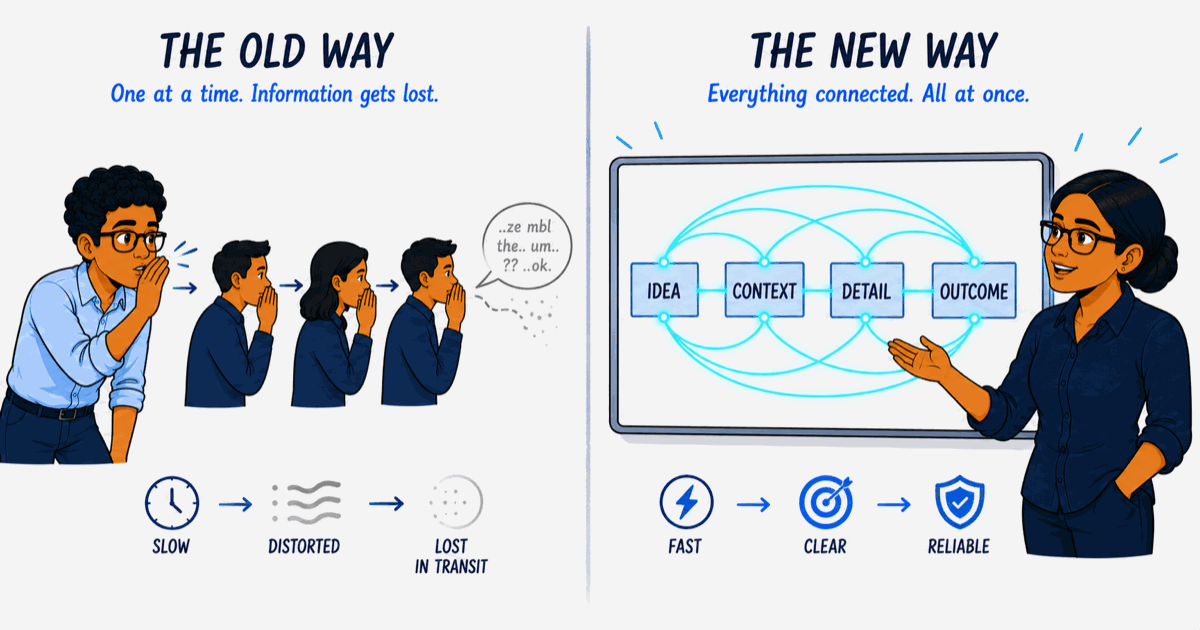
Key takeaways
- Attention lets every word in a text look at every other word directly, so meaning that depends on distant words survives.
- Because the whole text is handled at once rather than in a slow chain, these models could finally train on enormous data.
- The same maths that makes attention powerful sets a hard limit on how much text a model can hold at one time.
The old way read one word at a time, and it paid for it
To feel why attention mattered, picture the design it replaced. The earlier models read a sentence the way you might take a phone message, one word at a time, updating a short summary in your head as you go. By the end of a long passage that summary has been overwritten so many times that the opening is mostly gone. Worse, because each word has to wait for the summary from the word before it, the whole thing runs as a slow chain that cannot be sped up, even on hardware built to do thousands of things at once.
It is the difference between two ways of clearing a payment across borders. The old correspondent model passed a transaction through a line of intermediary banks, each one adding delay and compressing what it forwarded, so detail degraded at every hop. The modern network lets any bank talk to any other bank directly, in parallel, at steady speed. Attention did exactly that to reading. It stopped whispering a summary down a line and let every word reach every other word at once.
What attention actually does
Here is the whole idea in one picture. For every word in a sentence, the model asks a simple question, which other words here are relevant to me, and then it pulls in what those words offer, weighted by how relevant each one is. Nothing travels down a chain and nothing gets compressed into a single summary. Every word is connected directly to every other word, and the strength of each connection is learned from data. This is why the model can tell that in "river bank" the word "bank" leans on "river", while in "bank account" the very same word leans on "account". The word did not change. What changed is what it chose to pay attention to. That contextual reading, done for every word at the same time, is the entire trick, and it is powerful enough to sit under every large language model in use today.
Query, key, and value, without the jargon
When people describe attention they quickly reach for three words, query, key, and value. They sound technical and the idea underneath is not. Think of a search. Your query is what you are looking for. Every result advertises itself with a short label, its key. When you click, you get the actual content, its value. Attention runs that same search for every word at once. Each word sends out a query, compares it against the key that every other word advertises, and pulls in the value of the words that match best. Three roles, one familiar action.
In plain terms: query, key, value
Three roles every word plays at the same time. The query is what a word is looking for in the rest of the text. The key is what each word advertises it can offer. The value is the content a word actually contributes when another word decides it is relevant. Match queries to keys, then collect the values. That is attention, mechanically.
Many readers at once, each looking for something different
Real language carries several kinds of relationship at the same time. One thread is grammar, another is meaning, another is which word a pronoun refers back to. So the model does not run attention once. It runs several copies in parallel, and each copy learns to watch for a different kind of link. It works like a credit committee reading the same file. One member checks liquidity, another checks operational risk, another checks market exposure. Same document, different lenses, and the decision is stronger for combining all of them. This is called multi-head attention, and it is why a single pass can capture grammar and meaning and reference all at once.
Order has to be added back on purpose
There is a catch worth knowing, because it reveals how the machine really works. On its own, attention has no sense of order. To it, "the payment failed because the card expired" and the same words shuffled into nonsense look almost identical, because it is only weighing connections, not sequence. So each word is stamped with a marker for its position before attention begins. Strip that marker out and the model can no longer tell that a subject comes before its verb, or that "not" lands before the thing it cancels. Order is meaning, so order is added back deliberately.
Why one idea let AI suddenly get so much better
The deepest consequence is not about any single sentence. It is about scale. Because every word is handled at the same time rather than in a chain, this design uses modern hardware fully and trains efficiently on enormous amounts of text. And it rewards size in a predictable way. As the data, the model, and the computing budget grow, quality improves along a smooth and foreseeable curve, a relationship documented as scaling laws by Kaplan and colleagues in 2020. The older design never scaled like that. This is the concrete reason the field switched almost overnight. The first model of this kind, released in 2018, had 117 million adjustable parts. Later generations passed a trillion, and each jump bought a measurable gain rather than a dead end.
The same word, read two ways. Move the switch and watch which neighbour the model leans on. If scripting is off, the table below tells the same story.
| The sentence | The word in question | What it leans on | How it reads |
|---|---|---|---|
| The river bank flooded | bank | river | The edge of a river |
| The bank account froze | bank | account | A place that holds money |
What this means when you never touch the code
Two practical things follow, and both help you judge these systems. First, attention is why modern AI is so good at connecting ideas that sit far apart in a long document, a clause on page one that changes the meaning of a line on page forty. That is a genuine strength you can lean on. Second, the very thing that makes attention powerful, comparing every word with every other word, is expensive, and it grows sharply as the text gets longer. That is why every model has a hard ceiling on how much it can read at once.
In plain terms: the context window
The most text a model can hold in view at one time, counted in tokens rather than words. A token is a chunk of text, often a short word or a piece of one. A model advertised at 128,000 tokens handles roughly 90,000 to 100,000 words, and dense material like code eats the budget faster. When a long document seems to get "forgotten", this ceiling is usually why.
Ready-made models built on this design are now a few lines of code away, hosted in the hundreds of thousands on public hubs like Hugging Face, so almost no team builds one from scratch. That connects straight back to the through-line of this series on the shape of the problem. The mechanism is remarkable, and it still does not decide anything on its own. Someone has to know what it is strong at, where its limits bite, and which problem is actually worth pointing it at. That judgement is the work, and it stays with you.
Frequently asked questions
What is attention in AI, in plain terms?
Attention is a way for a model to let every word in a piece of text look directly at every other word and decide which ones matter to it. Instead of reading in order and keeping a fading summary, the model weighs the whole sentence at once. That is how it works out that in river bank the word bank leans on river, while in bank account it leans on account.
Why did attention replace the older way of reading text?
The older design read one word at a time and squeezed everything before into a single running summary, so it forgot the start of long text and could not be sped up, because each step waited for the last. Attention connects any two words directly and computes them all together, which removed the forgetting and let training run in parallel on modern hardware.
What are the query, key, and value in attention?
They are three roles every word plays at once, easiest to picture as a search. The query is what a word is looking for. The key is what each other word advertises it offers. The value is the content a word hands over when it is picked. The model matches queries against keys, then pulls in the values of the best matches.
Why does the number of words an AI can handle have a limit?
Attention compares every word with every other word, so the work grows sharply as the text gets longer. That sets a hard ceiling called the context window, measured in tokens rather than words. A model advertised at 128,000 tokens handles roughly 90,000 to 100,000 words, and code fills that budget faster than plain prose.
Why did this one change let AI suddenly get so much better?
Because it made scale pay off. With every position computed together, these models train efficiently on enormous data, and their quality improves in a predictable way as data, size, and computing budget grow. The first widely known model of this kind in 2018 had 117 million adjustable parts. Later ones passed a trillion.